I recently ran a landing page experiment for a long-time Google Ads client in the real estate industry, and I think the results are worth talking about.
This was not one of those situations where we took over a disaster account, fixed a bunch of obvious problems, and then results improved. Those situations happen, and they can be fun, but this was different. This was already a strong account. The client and I have done a really good job over time of building the account correctly, getting good conversion tracking in place, putting values on conversions, and making sure we are optimizing toward the kind of leads they actually want.
That’s what made the experiment interesting to me.
A lot of people think once a Google Ads account is working well, you just kind of leave it alone. And to be clear, there is some wisdom in not messing up a good thing. You do not want to constantly make big random changes to an account that is producing good results. But that does not mean the account is done.
Good accounts can still get better.
The Account Was Already Dialed In
One of the things this client has done well is separate the account by location priority.
They have high-priority locations where they want more volume, and where the conversions are more valuable to them. They also have low-priority locations where they still want conversions, but they do not want to spend as much money, and they understand that the leads from those locations are not worth quite as much to the business.
That sounds simple, but it is an important account structure decision. We are not treating every location the same because the business does not value every location the same. That is real-world Google Ads management. The account should reflect how the business actually works.
At the same time, we have not gone crazy splitting everything into too many campaigns. That’s another thing this client has done well. It can be tempting to create a million campaigns and segment everything to death, but if the budget is not large enough to support that, all you do is spread the data too thin and make the account harder to manage.
So we have a clean structure. High-priority locations in one campaign. Low-priority locations in another campaign. Enough separation to make different budget and optimization decisions, but not so much separation that the account becomes a scattered mess.
On top of that, the account has strong conversion tracking and conversion values in place. That matters a lot. When you have conversion values, you are not just saying, “A conversion happened.” You are saying, “This conversion is more valuable than that conversion.” That opens up a much better way to think about the account because the goal is not just lead volume. The goal is valuable lead volume at a cost that makes sense.
The Landing Page Test
The client recently built a landing page and wanted to test it against the homepage.
That is a classic Google Ads test, and it is a good one. Sometimes the homepage is the best place to send traffic because it gives people a full picture of the company. Sometimes a more focused landing page works better because it removes distractions and pushes people toward the action you want them to take.
You do not really know until you test it.
So we set up experiments in Google Ads. The idea was simple: keep the original campaigns running, but send half the traffic to the landing page and keep half the traffic going to the homepage. That way we could test the landing page without fully risking the current campaign performance.
That is one of the reasons I like Google Ads experiments. If the test works, you can apply it. If the test does not work, you end the experiment and the original campaign is still there. You are not just throwing a major change into the account and hoping it works.
For a mature account, that matters. You want to improve, but you do not want to be reckless.
The Results
The landing page performed very well in the high-priority locations campaign.
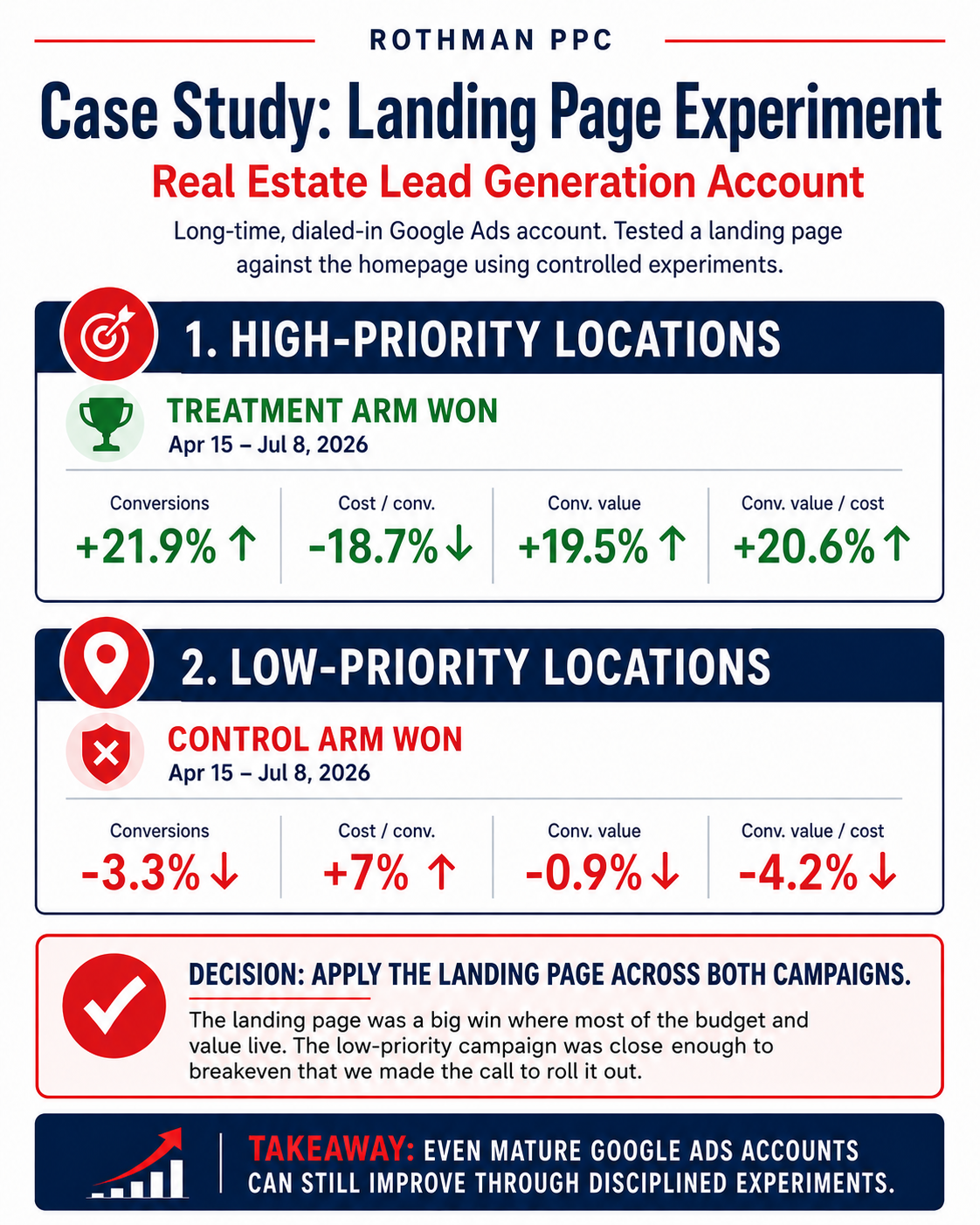
In that campaign, the treatment arm won. Conversions increased by 21.9%, cost per conversion decreased by 18.7%, conversion value increased by 19.5%, and conversion value divided by cost improved by 20.6%.
That is a strong result.
And it is especially strong because this was not a weak account where there were a bunch of obvious low-hanging fruit fixes to make. This was already a well-run, long-time account with good tracking, good structure, and a clear business goal. Improving conversions by more than 20% in that kind of account is a big deal.
The low-priority locations campaign was different. In that experiment, the control arm won. Conversions were down 3.3%, cost per conversion was up 7%, conversion value was down 0.9%, and conversion value divided by cost was down 4.2%.
So the landing page did not clearly win everywhere.
And honestly, that makes the test more realistic.
That is how Google Ads works. You do not always get one perfectly clean answer across every campaign, every location, and every segment of traffic. Sometimes one part of the account gives you a clear answer, and another part gives you a more mixed answer. Then you have to use judgment.
Why We Applied The Experiment
Based on the results, we decided to apply the landing page across both campaigns.
The high-priority locations campaign was the main reason. That is where we spend more of the budget, and that is where the client values the conversions more. The landing page won big in that campaign, and that was the campaign we cared about most.
The low-priority campaign was not as clear. The control technically won, and I am not ignoring that. But the results were fairly close, that campaign gets less budget, and it is less central to the account’s overall performance. Given how strongly the landing page performed in the high-priority campaign, we decided to make the call and roll it out.
That is a real account management decision.
Some people want every decision in Google Ads to be perfectly clean and obvious. That would be nice, but it is not always how it works. You look at the data, you understand the business priority, you understand where the budget is going, and then you make the best decision you can.
In this case, the landing page was a major win where most of the budget and value live. So we applied it.
The Bigger Lesson
The bigger lesson is that mature Google Ads accounts can still improve.
This account already had a lot going for it. It had a smart campaign structure. It had high-priority and low-priority locations separated correctly. It had conversion tracking. It had conversion values. It had a client who understands their business and understands that not all conversions are worth the same amount.
And even with all of that already in place, a landing page experiment still created a major improvement in the most important part of the account.
That is why I like experiments.
You can test big ideas without blowing up the account. You can test a landing page. You can test ad copy. You can test bidding strategies. You can test different approaches while protecting the original campaign from a full-risk change.
If the experiment works, great. Apply it.
If the experiment does not work, end it.
That is a great way to manage an account that is already working well but still has room to get better.
What We Are Testing Next
Now that the landing page test has been applied, the next thing we are looking at is ad copy.
The client has some new ad copy ideas they want to try, and we are going to test those through an experiment as well. That is exactly the right mindset. We are not just randomly changing ads in a mature account and hoping for the best. We are going to test the idea, look at the data, and then make a decision.
That is how good Google Ads accounts keep improving over time.
You build the account correctly. You track the right conversions. You understand the value of different types of leads. You structure the campaigns around the way the business actually works. And then, once the account is running well, you keep looking for ways to make it better.
Not reckless changes.
Disciplined experiments.
That is the mindset.
And in this case, that mindset helped a mature Google Ads account increase conversions by 21.9% in the campaign that mattered most.
